
THE COUNCIL
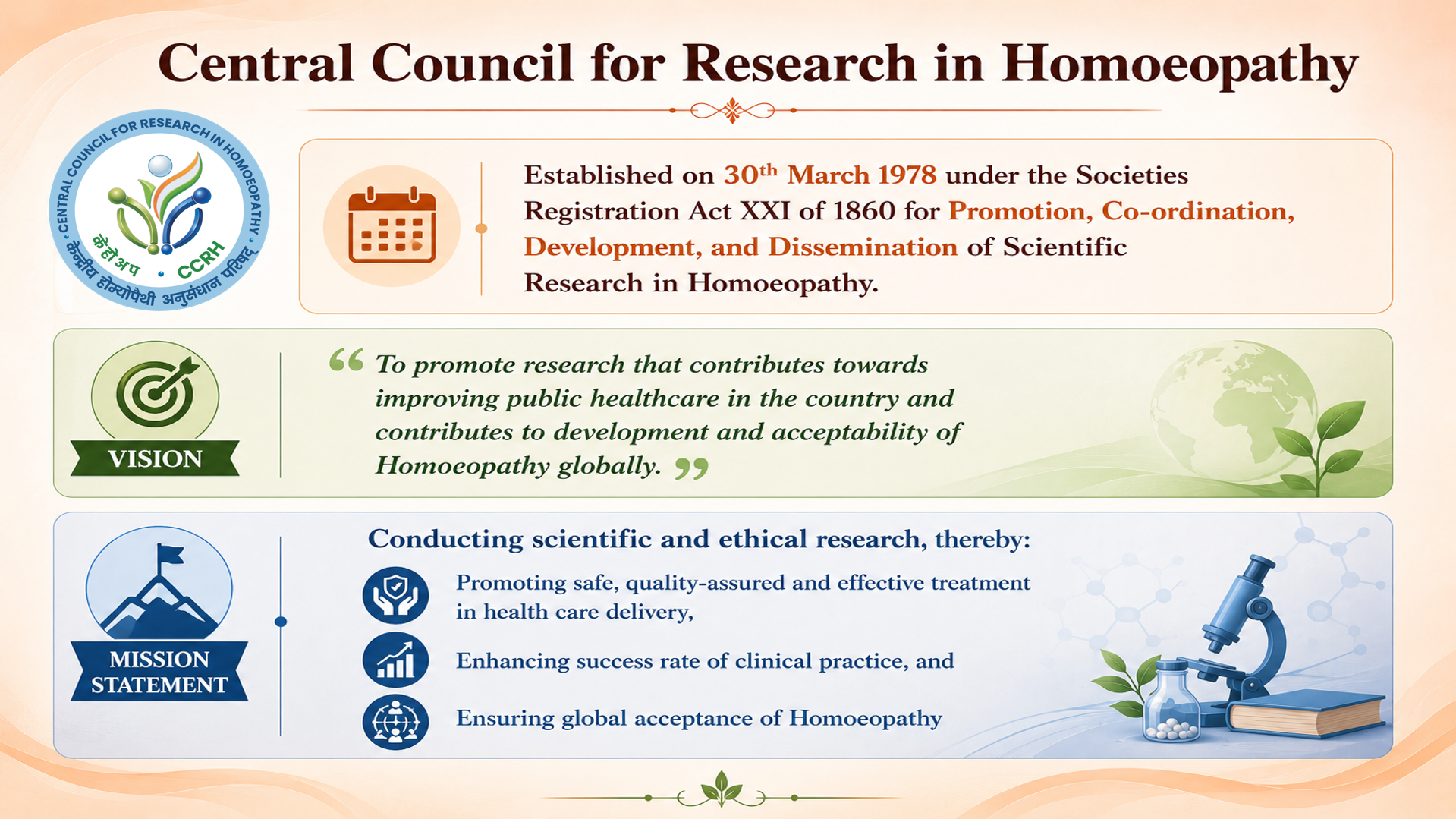
Central Council for Research in Homoeopathy (CCRH) is an apex research organization under Ministry of AYUSH, Govt. of India which undertakes, coordinates, develops, disseminates and promotes scientific research in Homoeopathy.
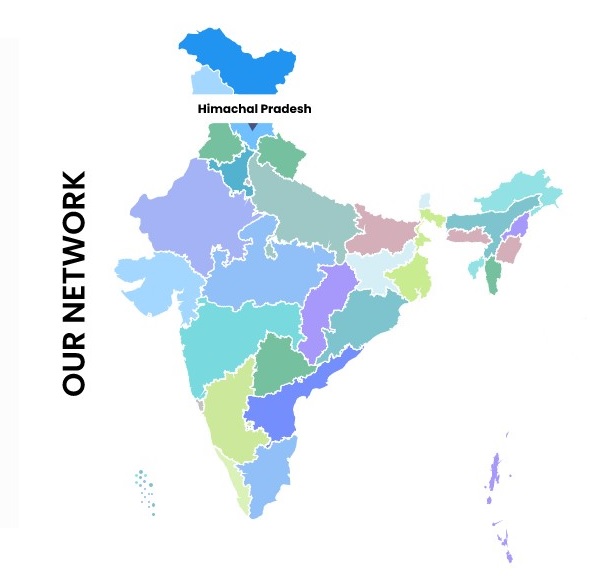
The Headquarters of the Council are situated in New Delhi and multi-centric research is conducted through a network of 33 institutes/units all over India.
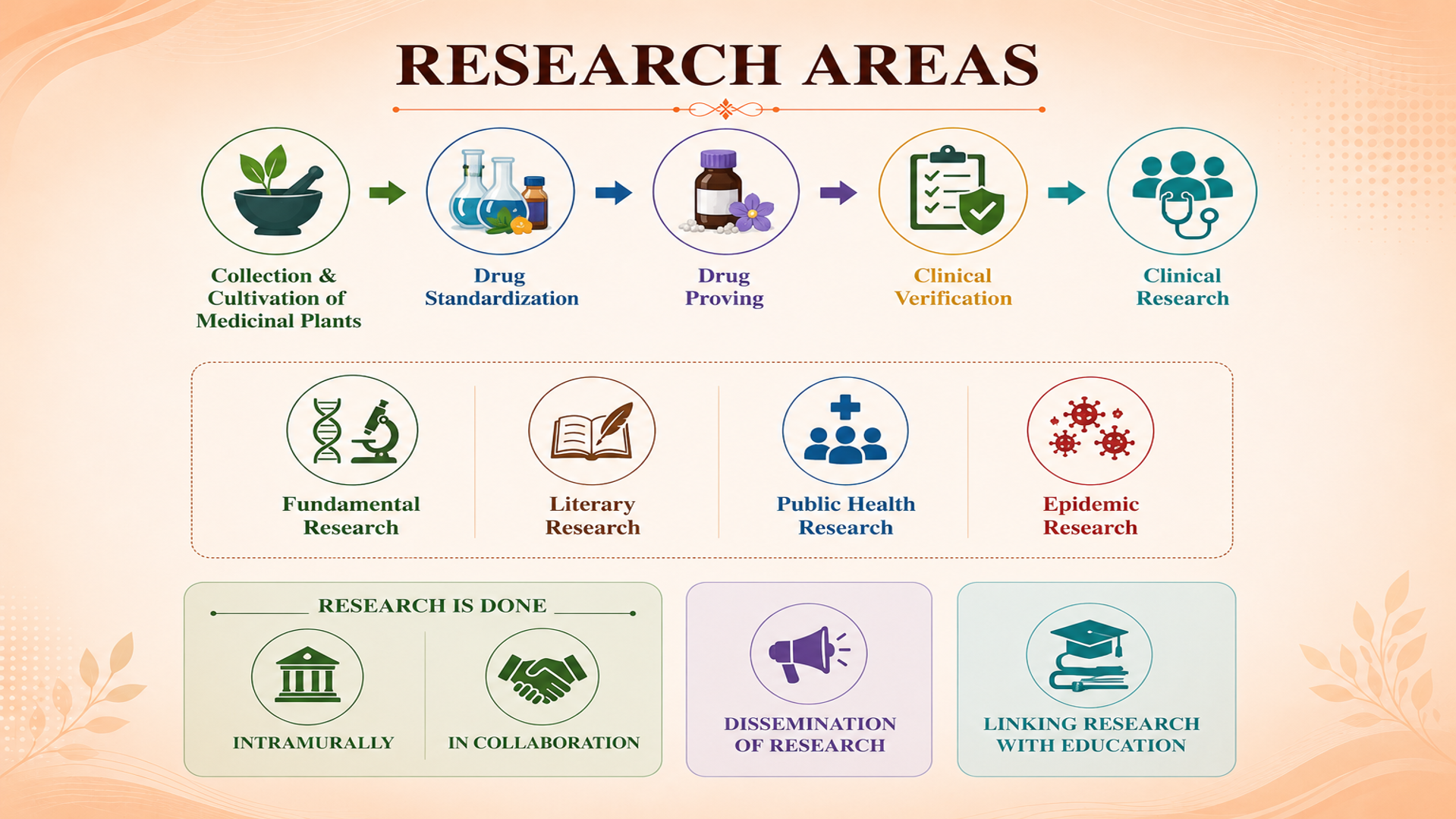
The Council formulates and conducts research programs/projects; collaborates with national and international institutes of excellence to undertake evidence based research in fundamental and applied aspects of Homoeopathy; monitors extra mural researches and propagates the research findings through monographs, journals, newsletters, I.E.&C. materials, seminars/workshops. Studies comply with the modern scientific parameters and research is undertaken with the goal that the outcome of research translates into practice and the benefit of the research is extended to the profession and the public.
The policies, directions and overall guidance for the activities of the Council are regulated by the Governing body. Hon’ble Minister of AYUSH, GOI presides over the governing body and has general control on the affairs of the Council.
Mode of Formation
The Government of India established a Central Council for Research in Indian Medicines and Homoeopathy (CCRIMH) in the year 1969 as an autonomous body under the Ministry of Health and Family Welfare to promote research and development in different Indian systems of medicine on scientific lines. However, with a view to have focussed research in each area of Indian systems of medicine and Homoeopathy, the CCRIMH was dissolved to pave way for the constitution of four separate research Councils, one each for Homoeopathy (CCRH), Ayurveda and Siddha Medicine (CCRAS), Unani Medicine (CCRUM) and Yoga & Naturopathy (CCRYN).
The Central Council for Research in Homoeopathy (CCRH), formally constituted on 30th March, 1978, was set up as an autonomous organization and registered under the Societies Registration Act XXI, 1860. CCRH is fully funded/controlled by the Ministry of AYUSH. The pattern of emolument structure, i.e. pay scales and allowances, Dearness Allowance, House Rent Allowance, Transport Allowances, etc. are identical to those in case of the Central Govt. employees.
Objectives
The objectives for which, the Central Council for Research in Homoeopathy is established, are:
- 1. To formulate aims and patterns of research on scientific lines in Homoeopathy.
- 2. To undertake any research or other related programmes in Homoeopathy including undergraduate, postgraduate and post-doctoral educational programmes in Homoeopathy.
- 3. To prosecute and assist in research, propagation of knowledge and experimental measures generally in connection with the causation, mode of spread, treatment and prevention of diseases.
- 4. To initiate, aid, develop and coordinate scientific research in different aspects, fundamental and applied aspects of Homoeopathy and to promote and assist institutions of research for the study of diseases, their prevention, causation, treatment and remedy.
- 5. To provide technical and financial support for research for the furtherance of objects of the Central Council.
- 6. To exchange information with other institutions, associations and societies interested in the objects similar to those of the Central Council and specially in observation and study of diseases in East Asia and in India, in particular.
- 7. To establish, equip and maintain laboratories, libraries, institutions and other facilities necessary to fulfil the objects of the Central Council.
- 8. To prepare, print, publish and exhibit any papers, posters, pamphlets, periodicals, standard treatment protocols and books for furtherance of the objects of the Central Council and to contribute to development of such literature.
- 9. To issue appeals and make applications for money and funds in furtherance of the objects of the Central Council and to accept for the aforesaid purpose gifts, donations and subscriptions of cash and securities and of any property whether movable or immovable.
- 10. To borrow or raise monies with or without security or on security mortgage charge, hypothecation or pledge of all or any of the immovable or movable properties belonging to the Central Council or in any other manner whatsoever.
- 11. To invest and deal with the funds and monies of the Central Council or entrusted to the Central Council not immediately required in such manner as may from time to time be determined by the Governing Body of the Central Council.
- 12. To permit the funds of the Central Council to be held by the Government of India.
- 13. To acquire and hold, whether temporarily or permanently any movable or immovable property necessary or convenient for the furtherance of the objects of the Central Council.
- 14. To sell, lease, mortgage and exchange, and otherwise transfer any of the properties movable or immovable of the Central Council provided prior approval of the Central Government is obtained for the transfer of immovable property.
- 15. To purchase, construct, maintain and alter any buildings, including for establishment of research laboratories, libraries or works necessary or convenient for the purpose of the Central Council.
- 16. To undertake and accept the management of any endowment or trust fund for donation, the undertaking or acceptance whereof may seem desirable.
- 17. To offer prizes and grant fellowship, scholarships, or financial assistance including travelling assistance in furtherance of the objects of the Central Council.
- 18. To create administrative, technical and ministerial and other posts under the Society and to make appointments thereto in accordance with the rules and regulations of the Society.
- 19. To engage administrative, technical, ministerial and other staff under the project on contract basis in accordance with the procedure laid down by the Executive Committee.
- 20. To establish a provident fund and/or pension fund for the benefit of the Central Council's employees and/or their family members.
- 21. To organize and participate in national and international programmes in Homoeopathy.
- 22. To undertake R&D Consultancy projects and transfer of patents on drugs and process to industry.
- 23. To undertake R&D projects sponsored by industries in Public/Private Sector.
- 24. To undertake International and inter-agency collaboration.
- 25. To utilise results of research conducted and payment of share of royalties/ consultancy fees to those who have contributed towards pursuit of such research.
- 26. To enter into agreement with scientific agencies of other countries for exchange of scientists, study tours, training in specialized areas, conducting joint projects etc.
- 27. To provide technical assistance to Govt./Private agencies in matters consistent with the activities of the Council.
- 28. To collaborate with, Government of India, in Research and Scientific Institutions, Academics in achieving its objectives.
- 29. To constitute Management Committees consisting of eminent Scientists/Physicians to monitor the R&D activities and suggest remedial measures for the improvement of activities of the Central Council as well as all Research Institutes of the Council.
- 30. To do all such other lawful things either alone or in conjunction with others, as the Central Council, may consider necessary or as being incidental or conducive to the attainment of the above objects.
A glimpse of the activities of the Council
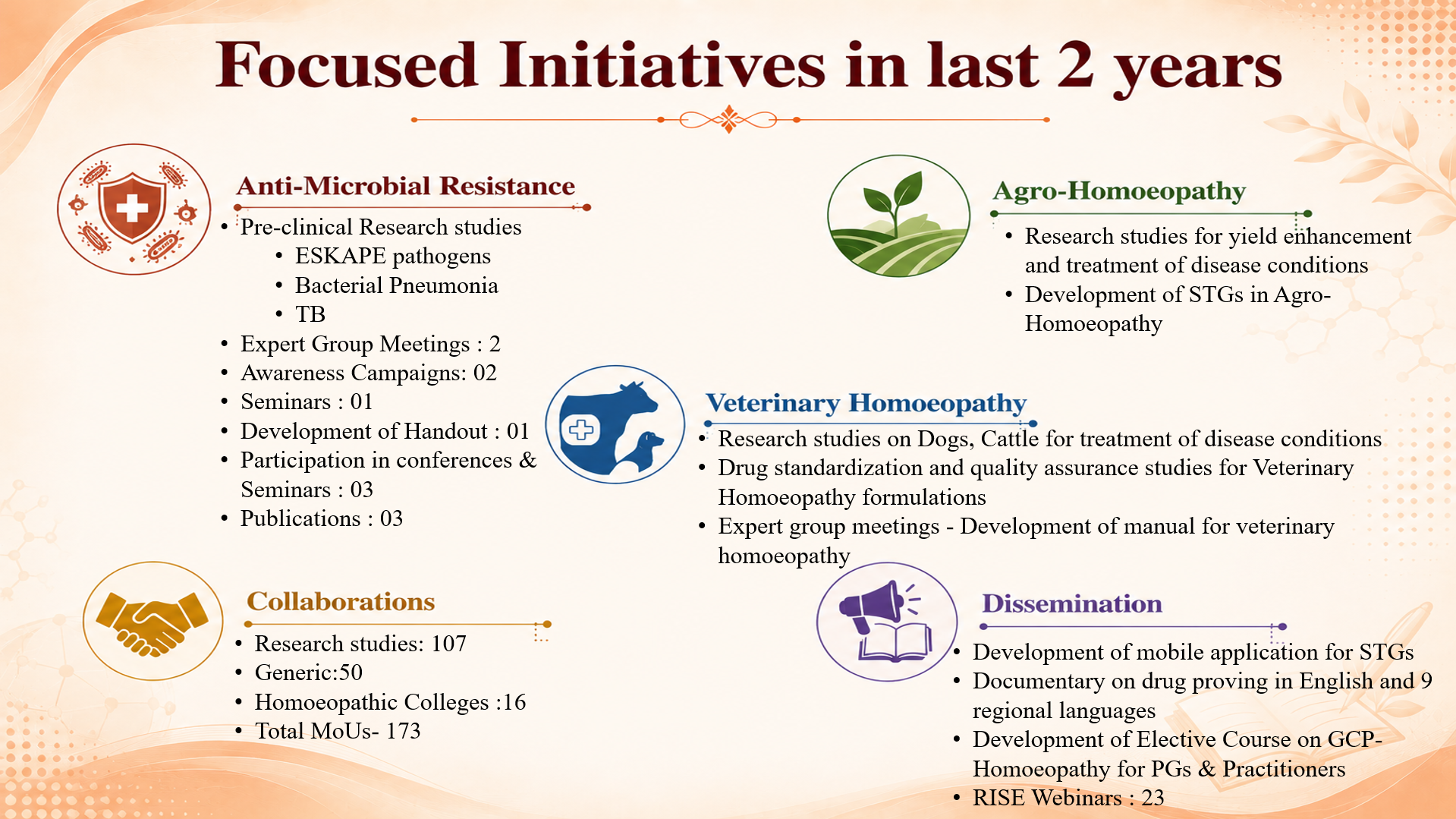
Initiatives taken in last 2 Years
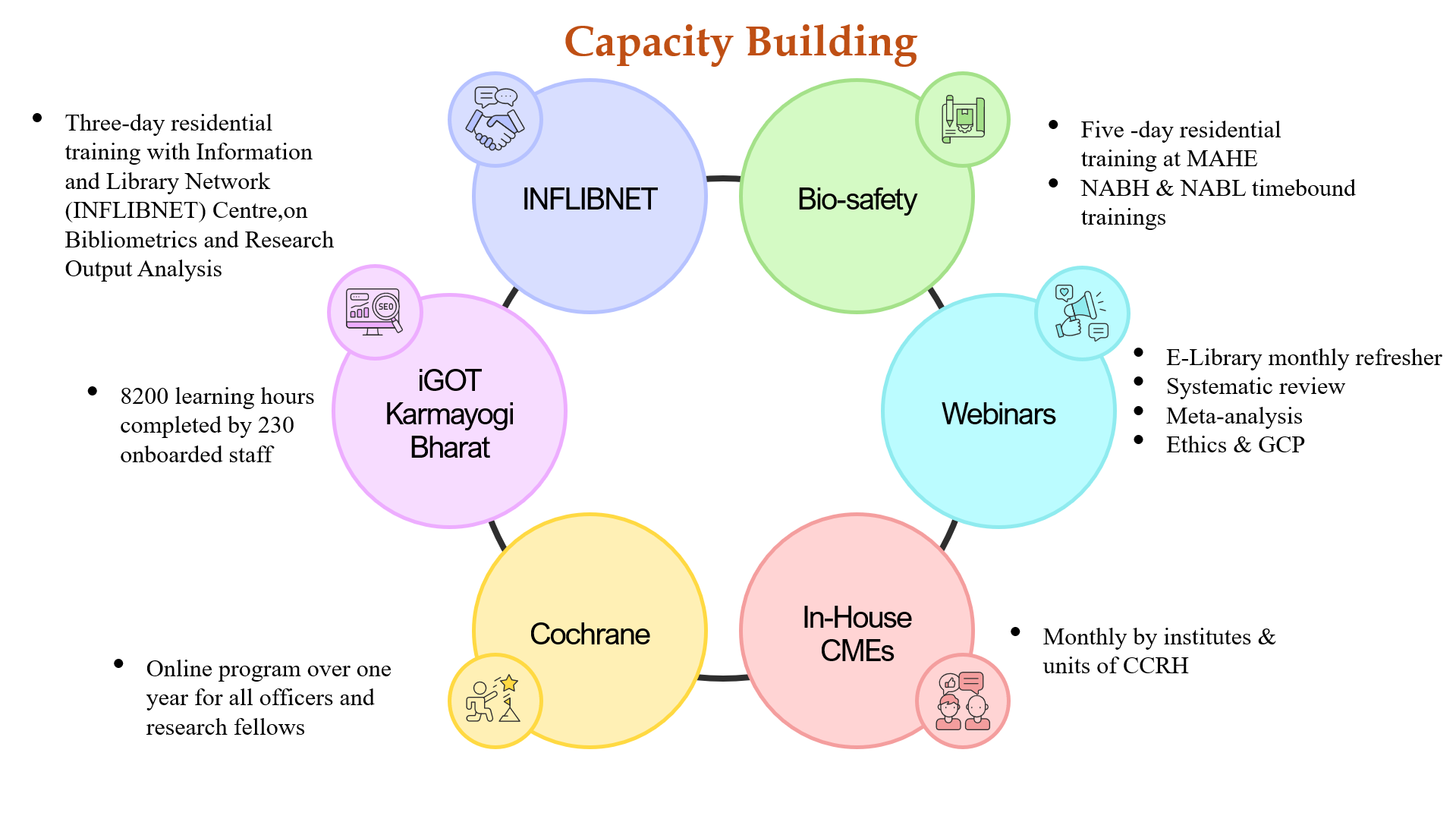
Capacity Building Initiatives
| Total number of sanctioned posts, category-wise. |
Group A - 127 Group B - 94 Group C - 231 Total - 452 |
| Number of regular employees |
Group A - 109 Group B - 45 Group C - 94 Total - 248 |
| Number of contractual employees |
Technical Staff (Research Fellows/Associates/Consultants) - 231 Technical supporting staff (Nurse/Technicians) - 39 Non Technical staff (Group C & D) - 290 Total : 560 |
| Number of employees on deputation |
Group A- 01 (from outside organization to CCRH) Group A- 01 (from CCRH to outside organization) |


.png)

.png)